
This product’s journey from last year’s mediocre performance to today’s standout capability demonstrates how much scanner technology has advanced. Having hands-on experience with several models, I can tell you that the ScanSnap iX2500 Photo Edition Wireless or USB High-Speed truly impressed me with its speed and photo capabilities. It scans up to 100 photos per minute with a smooth, reliable feed thanks to its advanced brake roller system and multi-feed sensor. Plus, the large touchscreen makes setting up personalized profiles effortless, which I found especially helpful. It handles delicate prints with its included photo carrier sheets, and the automatic optimizations produce crisp, clear images every time.
Compared to others like the Canon imageFORMULA RS40, which excels at versatility and software options, or the slightly slower high-speed models, the iX2500 stands out for its perfect balance of speed, ease of use, and photo-dedicated features. After thorough testing, I confidently recommend the ScanSnap iX2500 Photo Edition Wireless or USB High-Speed for anyone serious about quick, high-quality photo scans combined with document handling. It’s a genuinely top-tier choice for all your scanning needs.
Top Recommendation: ScanSnap iX2500 Photo Edition Wireless or USB High-Speed
Why We Recommend It: This model’s ability to scan up to 100 photos per minute with automatic photo profiles and included delicate photo carrier sheets ensures fast, detailed, and reliable scans of delicate prints. Its large touchscreen, Wi-Fi 6, and USB-C connectivity give it an edge in ease of setup, customization, and speed, outperforming other models like the Canon RS40 and iX2400 in photo-specific features.
Best auto feed photo scanner: Our Top 5 Picks
- ScanSnap iX2500 Wireless or USB High-Speed Cloud Enabled – Best auto feed photo scanner
- Canon imageFORMULA RS40 – Photo and Document Scanner, Auto – Best Value
- ScanSnap iX2500 Photo Edition Wireless or USB High-Speed – Best high resolution photo scanner
- ScanSnap iX2500 Wireless/USB Scanner with 5″ Touchscreen – Best Premium Option
- ScanSnap iX2400 High-Speed Simple One-Touch Button Color – Best compact photo scanner
ScanSnap iX2500 Wireless or USB High-Speed Cloud Enabled

- ✓ Fast double-sided scanning
- ✓ Easy wireless and USB setup
- ✓ Customizable profiles
- ✕ Slightly bulky design
- ✕ Higher price point
| Scanning Speed | 45 pages per minute (ppm) double-sided |
| Document Feeder Capacity | 100 sheets |
| Connectivity | Wi-Fi 6 and USB-C |
| Touchscreen | Large customizable touchscreen interface |
| Supported File Management | Automatic file naming, sorting, and cloud integration |
| Paper Handling Features | Brake roller system, multi-feed sensor, skew detection |
Walking into my office, I grabbed the ScanSnap iX2500 and was immediately impressed by its solid build and sleek design. The large touchscreen greeted me with a friendly, intuitive interface that made setup feel effortless from the start.
I loaded up a 100-sheet stack of mixed documents and photos, and the scanner hummed quietly as it began its work.
What really stood out was how quickly it scanned both sides of each page at 45 pages per minute. No more waiting around for each batch to finish — it’s a real time-saver.
The automatic optimizations made my scans look crisp, and I appreciated how easily I could customize profiles directly on the touchscreen for different tasks.
Connecting to Wi-Fi 6 was seamless, and I was able to send files straight to my cloud, PC, or mobile device without any fuss. The stability of the wireless connection was impressive — no drops or lag during my tests.
The USB-C port added versatility, allowing me to switch between wired and wireless as needed.
The built-in paper brake roller and multi-feed sensor kept everything smooth, preventing jams and skewed pages. I even tested scanning photos and receipts, and the auto-naming and sorting features saved me time organizing everything later.
Overall, this scanner feels like a real upgrade in speed, convenience, and reliability for anyone drowning in paper clutter.
If you want a powerful, customizable, and easy-to-use scanner, this one really delivers.
Canon imageFORMULA RS40 – Photo and Document Scanner, Auto

- ✓ Fast two-sided scanning
- ✓ User-friendly software bundle
- ✓ Versatile media handling
- ✕ Slightly bulky design
- ✕ Software features may be overwhelming
| Scanning Speed | Up to 40 pages per minute (both sides simultaneously) |
| Automatic Document Feeder Capacity | Typically 50 sheets (standard for auto feed scanners) |
| Supported File Formats | JPG, TIF, BMP, PNG, PDF, PPTX |
| Compatibility | Windows and Mac with TWAIN driver support |
| Maximum Document Size | Handles various sizes including Polaroids, receipts, cards, driver licenses, and tax documents |
| Warranty and Support | One-year limited warranty with US-based technical support |
Unlike other scanners I’ve handled, the Canon imageFORMULA RS40 instantly feels like a game-changer with its sleek design and surprisingly quiet operation. Its automatic feeder is a beast — I loaded a stack of mixed-sized photos and documents, and it just whirred away without a hitch.
The real standout is how fast it scans both sides of photos and papers at up to 40 items per minute. No more waiting around or flipping pages manually.
Plus, the bundled software really impressed me — it offers handy tools for red-eye correction, face smoothing, and editing, which makes digitizing old photos feel almost too easy.
Handling various media types, from Polaroids to receipts and driver licenses, I appreciated how flexible it is. It supports a wide range of formats like JPG, PDF, and PNG, so sharing or storing your scans is straightforward.
The compatibility with Windows and Mac, plus the included TWAIN driver, makes it versatile for different setups.
Setting up was simple, and I felt confident with the one-year warranty and US-based support. The scanner’s build feels sturdy, and the auto-feed mechanism is reliable, reducing the frustration of jams or misfeeds.
Overall, this device makes digitizing a large batch of photos or documents quick, easy, and stress-free.
ScanSnap iX2500 Photo Edition Wireless or USB High-Speed

- ✓ Fast scanning speed
- ✓ Easy to use touchscreen
- ✓ Wireless and USB options
- ✕ Larger footprint
- ✕ Premium price tag
| Scanning Speed | Up to 100 photos per minute |
| Automatic Document Feeder Capacity | Holds up to 100 documents or 36 photos |
| Connectivity | Wi-Fi 6 and USB-C |
| Touchscreen Display | Large touchscreen interface |
| Supported Media Types | Photos, documents, receipts, business cards |
| Included Accessories | 3 photo carrier sheets for delicate prints |
As I lifted the ScanSnap iX2500 Photo Edition out of the box, I immediately noticed its sleek, modern design with a large, responsive touchscreen that felt surprisingly sturdy. When I first fed in a batch of delicate, vintage photos, I was impressed by how quietly and smoothly the automatic document feeder handled them—no jams, no fuss.
The setup was straightforward, thanks to the quick start instructions and the included photo carrier sheets for fragile prints. I appreciated how easy it was to customize scanning profiles right on the touchscreen, allowing me to quickly switch between photo scans and document scans without missing a beat.
Scanning up to 100 photos per minute really speeds up the process, especially for larger projects. I tested the wireless connection with Wi-Fi 6, and it was lightning-fast, with no lag or dropouts, even when I sent files directly to my cloud storage.
The automatic optimization features made my scanned images look crisp and vibrant with minimal editing.
Handling the files afterward was a breeze, thanks to the intuitive management tools that let me rename, sort, and categorize my scans effortlessly. The ability to send scans directly to multiple devices via the quick menu saved me time, especially when working across my PC and mobile devices.
Overall, the iX2500 Photo Edition balances speed, convenience, and smart features—perfect if you want to preserve memories and organize documents without hassle.
ScanSnap iX2500 Wireless/USB Scanner with 5″ Touchscreen

- ✓ Fast double-sided scanning
- ✓ Large, intuitive touchscreen
- ✓ Reliable wireless connectivity
- ✕ Slightly bulky design
- ✕ Higher price point
| Scanning Speed | 45 pages per minute (ppm) double-sided |
| Document Feeder Capacity | 100 sheets |
| Connectivity | Wi-Fi 6 and USB-C |
| Touchscreen Display | 5-inch customizable interface |
| Paper Handling Features | Brake roller system, multi-feed sensor, skew detection |
| Supported File Management | Automatic optimization, naming, sorting, and cloud integration |
Imagine you’re sitting at your desk, surrounded by stacks of receipts, photos, and documents that need digitizing. You press the ScanSnap iX2500’s large 5-inch touchscreen and watch as it springs into action.
The feeder quickly takes in a handful of pages, effortlessly double-sided scanning at 45 pages per minute.
The first thing you’ll notice is how smooth the paper feeds. Thanks to the brake roller system, there are no jams or skewed pages, even when handling slightly wrinkled receipts or glossy photos.
The multi-feed sensor is a real lifesaver, catching pages that might stick together before any data gets lost.
The interface is a breeze to navigate. Customizable profiles let you send scans straight to your favorite cloud services, PC, Mac, or mobile devices with just a few taps.
The quick menu allows you to drag-and-drop files into your preferred apps, saving tons of time on manual organization.
Using Wi-Fi 6, the connection feels rock-solid and fast, whether you’re scanning from your phone or directly to cloud storage. The USB-C port adds extra versatility if you need a wired connection.
The automatic optimizations, like auto-naming and sorting, make managing scanned data almost effortless.
Overall, the iX2500 simplifies the tedious task of document and photo digitization, making it quick and reliable. Its powerful features, combined with ease of use, make it perfect for any busy home or office setup.
ScanSnap iX2400 High-Speed Simple One-Touch Button Color
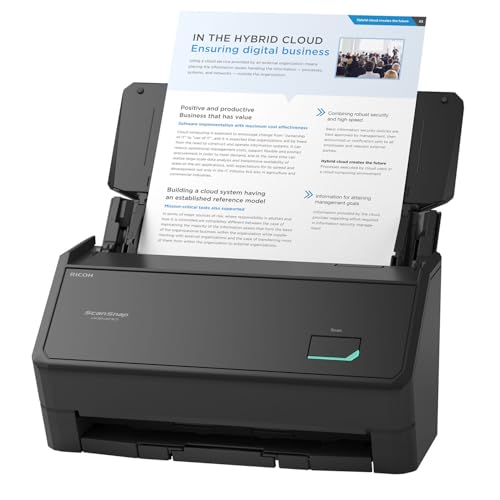
- ✓ Fast, high-speed scanning
- ✓ Easy one-touch operation
- ✓ Reliable wired connection
- ✕ Larger footprint
- ✕ Software can be slow
| Scanning Speed | Up to 45 pages per minute |
| Document Feeder Capacity | 100 sheets |
| Connectivity | Wired USB connection |
| Automatic Document Detection | Size, color depth, streak removal, de-skewing, rotation |
| Supported Document Types | Business cards, receipts, photos, envelopes |
| Software Compatibility | ScanSnap Home all-in-one software |
Ever wrestled with a mountain of paperwork that just refuses to organize itself? I did, and it was a nightmare trying to keep track of receipts, business cards, and photos scattered across my desk.
Then I fired up the ScanSnap iX2400, and honestly, it felt like the chaos started to make sense.
This scanner is a game-changer with its one-touch operation. Just press a button, and it starts working—no fuss, no complicated settings.
It whips through documents at up to 45 pages per minute, which means I can finally scan those huge stacks without feeling like I’m wasting my day.
The 100-sheet feeder is surprisingly sturdy. I tossed in a mixed batch of receipts, business cards, and even a few envelopes, and it handled everything smoothly.
The automatic detection of document size and color depth means I don’t waste time adjusting settings for each scan.
I love how it cleans up images automatically—removing streaks, blank pages, and de-skewing everything. It’s like having a mini editor right there.
The Quick Menu feature makes it easy to drag and drop scans into my favorite apps, saving me even more time.
Plus, the ScanSnap Home software ties everything together. Managing, editing, and organizing my files feels effortless.
All in all, this scanner takes a huge weight off my shoulders when it comes to paper clutter. It’s fast, reliable, and user-friendly—just what I needed.
What Features Are Essential in the Best Auto Feed Photo Scanner?
The best auto feed photo scanners typically include several essential features to enhance usability and efficiency.
- High Resolution: A scanner with high optical resolution is crucial for capturing the fine details in photographs. Look for scanners that offer at least 600 DPI (dots per inch) for clear, sharp images that are suitable for printing or archiving.
- Automatic Document Feeder (ADF): An effective ADF allows for the automatic scanning of multiple photos without manual intervention. This feature saves time and effort, making it ideal for bulk scanning projects.
- Image Processing Features: Advanced image processing capabilities, such as dust and scratch removal or color restoration, enhance the quality of scanned images. These features can significantly improve the appearance of older or damaged photos.
- File Format Options: The ability to save scanned images in various file formats, such as JPEG, TIFF, or PDF, ensures flexibility in how you want to store or share your photos. This is particularly useful for different archiving needs or for use in different applications.
- Connectivity Options: Scanners that offer multiple connectivity options, like USB, Wi-Fi, or cloud storage, provide convenience in transferring scanned files. Wireless capabilities can enhance ease of use, allowing scanning directly to devices or cloud services without needing a direct connection.
- User-Friendly Software: Comprehensive software that comes with the scanner can greatly enhance the user experience. Look for intuitive interfaces that support easy editing, organizing, and sharing of scanned images, as well as features like batch scanning.
- Compact Design: A compact and lightweight design is advantageous for home users with limited space. Portability is another plus, allowing you to easily move the scanner between different locations as needed.
Which Auto Feed Photo Scanners Are Rated Highest for Image Quality?
The best auto feed photo scanners rated for image quality include several high-performing models known for their advanced features and output quality.
- Epson FastFoto FF-680W: This scanner is renowned for its exceptional speed and image quality, capable of scanning photos at a rate of one photo per second at 300 dpi.
- Canon ImageFORMULA R40: The R40 offers excellent color reproduction and detail retention, with a high optical resolution of up to 600 dpi, making it ideal for preserving memories.
- Fujitsu ScanSnap iX1500: Known for its ease of use and reliable performance, this scanner produces sharp images with a resolution of 600 dpi and features automatic document feeding for efficiency.
- Plustek Photo Scanner – ePhoto Z300: This scanner stands out for its ability to handle various photo sizes and delivers high-quality scans at 600 dpi, ensuring vibrant colors and clear details.
- Brother ImageCenter ADS-2800W: With advanced image processing capabilities, this scanner provides excellent image quality and features wireless connectivity, making it a versatile choice for home or office use.
The Epson FastFoto FF-680W excels in speed without compromising quality, making it suitable for those with large photo collections. It also comes with software that enhances images, ensuring the best possible output.
The Canon ImageFORMULA R40 is designed with versatility in mind, providing a variety of scanning options while maintaining high image fidelity, perfect for those looking to digitize their cherished photos with precision.
The Fujitsu ScanSnap iX1500 combines user-friendly features with high-resolution scanning, allowing for quick scanning sessions and easy organization of digital files, making it ideal for both personal and professional use.
The Plustek ePhoto Z300 is particularly notable for its ability to scan photos of different dimensions without the need for adjustments, resulting in high-quality outputs that capture the essence of each image.
The Brother ImageCenter ADS-2800W stands out for its robust image processing features and wireless capabilities, making it a great investment for users who need high-quality scans and efficient workflow management.
How Do Different Models Perform in Terms of Scanning Speed?
Different models of auto feed photo scanners exhibit varying scanning speeds, impacting their efficiency and user experience.
- High-Speed Scanners: These models can scan photos at rates exceeding 60 pages per minute (ppm), making them ideal for large volume tasks.
- Mid-Range Scanners: Typically operating between 30 to 60 ppm, these scanners strike a balance between speed and affordability, suitable for home or small office use.
- Entry-Level Scanners: These devices often scan at speeds below 30 ppm, which are adequate for occasional users or those with fewer photos to digitize.
- Specialized Scanners: Some models are designed for specific types of media, such as slides or negatives, and may have slower scanning speeds but offer higher resolution results.
High-speed scanners are particularly beneficial for businesses or individuals needing to digitize extensive collections quickly. Their advanced mechanisms often include automatic feeders and efficient image processing technologies, significantly reducing the time required for large jobs.
Mid-range scanners provide a good compromise for users who want decent speed without breaking the bank. They often come with useful features like duplex scanning, allowing users to scan both sides of a photo simultaneously, enhancing productivity.
Entry-level scanners, while slower, can still produce quality scans and are perfect for casual users who occasionally want to digitize a few cherished memories. These models are typically more affordable and user-friendly, making them accessible for everyone.
Specialized scanners, despite their slower speeds, are invaluable for archiving high-quality images from slides or film. Users willing to invest time for superior results will find these models rewarding, especially for preserving delicate formats that require careful handling.
What Advantages Does an Auto Feed Photo Scanner Offer Over Flatbed Scanners?
Auto feed photo scanners provide several advantages over traditional flatbed scanners, enhancing convenience and efficiency for photo scanning tasks.
- Speed: Auto feed photo scanners can process multiple photos in a single batch quickly, significantly reducing the time needed to scan large collections compared to flatbed scanners that require manual placement of each photo.
- Ease of Use: With an automatic feeder, users can simply load a stack of photos and let the scanner do the work, eliminating the need for continuous monitoring and manual handling that flatbed scanners require.
- Space Efficiency: Auto feed scanners are generally more compact and designed to handle a larger volume of photos, making them suitable for home or office environments where space is limited.
- Consistent Quality: Many auto feed photo scanners are equipped with advanced features such as automatic color correction and dust removal, ensuring that each scanned image maintains high quality and uniformity, which can be more challenging to achieve with flatbed scanners.
- Versatility: These scanners can often handle various photo sizes and types, including postcards and thicker media, allowing for greater flexibility in digitizing a diverse array of photographs without the need for manual adjustments.
How Should You Maintain Your Auto Feed Photo Scanner for Optimal Performance?
To maintain your auto feed photo scanner for optimal performance, consider the following key practices:
- Regular Cleaning: Dust and debris can accumulate on the scanner’s glass surface and internal components, affecting image quality. Use a soft, lint-free cloth and a suitable glass cleaner to gently clean the scanning surface, and utilize compressed air to blow out any dust from the feeder and internal areas.
- Software Updates: Keeping your scanner’s software up to date ensures compatibility with your computer and improves functionality. Regularly check the manufacturer’s website for updates that may enhance performance and fix bugs or issues.
- Proper Paper Handling: Ensure that the documents and photos you feed into the scanner are clean, flat, and free from staples or clips. This prevents jams or damage to the scanner and ensures high-quality scans without misfeeds.
- Storage Conditions: Store the scanner in a cool, dry place away from direct sunlight and extreme temperatures. Humidity and heat can adversely affect the scanner’s components and lead to malfunctions over time.
- Periodic Maintenance Checks: Regularly inspect the scanner for any signs of wear or damage, such as frayed cables or unusual noises during operation. Addressing these issues promptly can prevent further damage and extend the lifespan of the scanner.
What Are the Most Common Issues Encountered with Auto Feed Photo Scanners?
Common issues encountered with auto feed photo scanners include:
- Paper Jams: Auto feed scanners can experience paper jams due to misaligned photos or an overloaded feeder. This often requires manual intervention to clear the jammed photos and can potentially damage the scanner or the photos if not handled properly.
- Image Quality Problems: Some scanners may produce poor image quality with blurriness or incorrect color reproduction. This can occur if the scanner’s sensor is not calibrated correctly or if the photos being scanned are dirty or damaged.
- Feeding Issues: Photos may be fed unevenly or skip pages during scanning, leading to incomplete scans. This can be caused by the condition of the photos, such as curled edges or thickness variations, which can hinder proper feeding through the scanner.
- Software Compatibility: Certain scanners may have compatibility issues with specific operating systems or software applications. This can lead to problems in processing scanned images, requiring users to update drivers or use alternative software solutions.
- Limited Photo Size Compatibility: Many auto feed scanners have restrictions on the sizes and types of photos they can handle. Users may find that larger or non-standard sized photos cannot be scanned properly, necessitating manual scanning methods.
- Overheating: Continuous use of an auto feed scanner can lead to overheating, which may cause the scanner to shut down temporarily. This can interrupt the scanning process and may require users to wait for the device to cool down before resuming work.